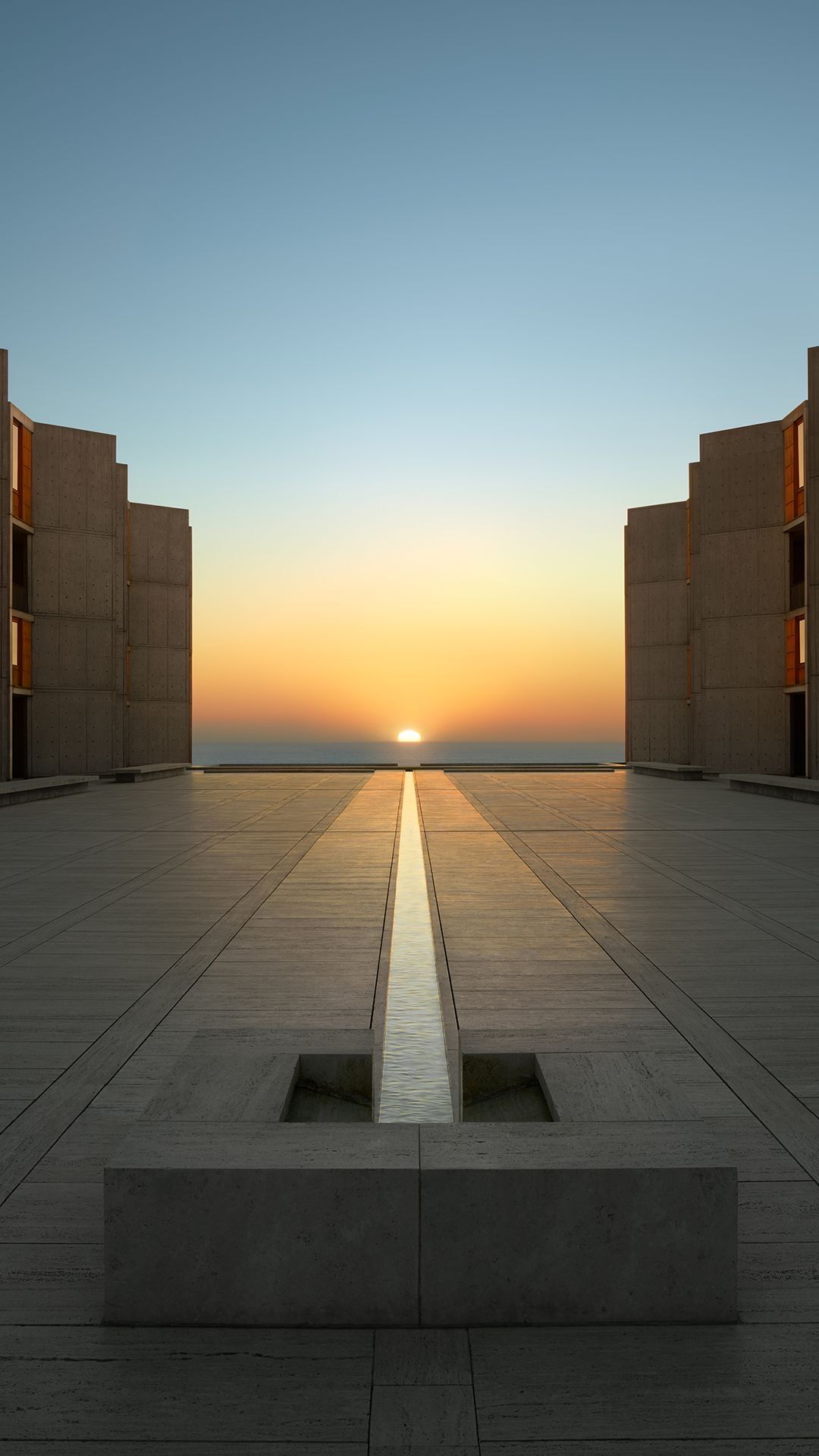
Louis Kahn, Salk Institute
Symmetry is usually associated with grandeur. At the Salk Institute, Louis Kahn used it to produce the opposite: silence.
At the Salk Institute in La Jolla, two identical blocks of laboratories face each other across a court of travertine, and a single narrow channel of water runs down the centre of that court to its edge, where it meets the line of the Pacific. The composition is absolutely symmetrical, and almost empty.
The effect is not monumental but still. Because the two sides are equal and the axis is left open, the eye has nothing to resolve. It travels straight down the channel to the horizon. The body registers the balance, and quiets. Kahn understood that symmetry, stripped of ornament, stops being about the building and becomes a way of framing the sky and the sea.
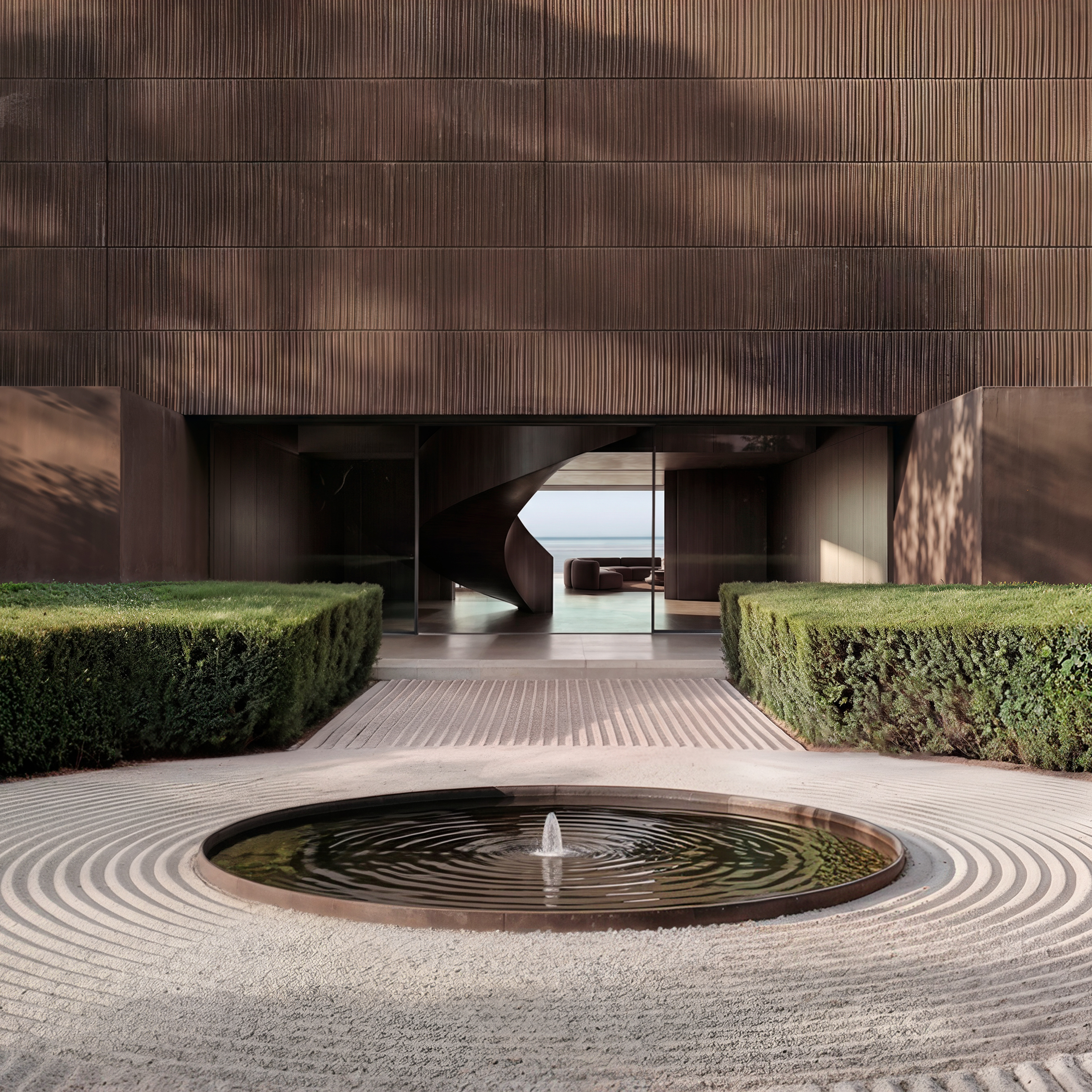
That is the lesson this house takes, and it is a lesson about feeling, not about form. The central axis runs, like Salk's channel of water, from the closed entrance straight through the house to the sea. The two wings are identical; the centre is held by the double-height hall and the helical stair, then released to the water. The symmetry is there to produce stillness, to let the horizon, and not the architecture, be the subject.
The reference is not the material, though both buildings happen to use travertine. It is the discipline beneath it: absolute symmetry used as an instrument of calm, a way of arriving at quiet rather than at spectacle.